


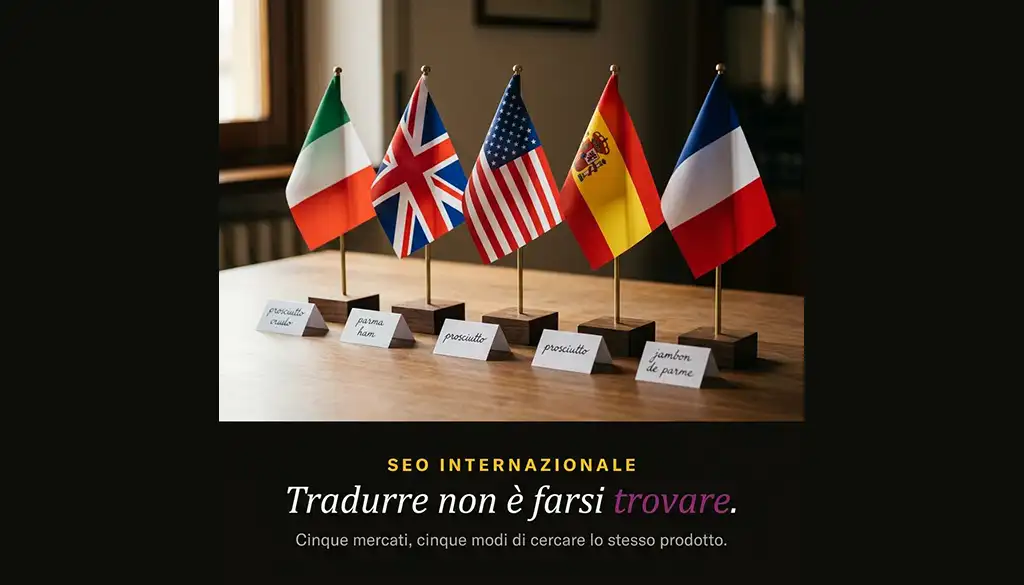
A food company translates its website into English, French, and Spanish. Six months later, three inquiries come in from abroad. The website is accurate, the language is flawless, and the translator did a good job. So where did the process break down?
The answer lies in a table of numbers that almost everyone overlooks: the way people search for the same product in different countries.
We took “prosciutto crudo” and tracked it across five markets. The results explain why a perfect translation can go unnoticed—and in which cases it makes sense to switch to an international SEO strategy.
What’s the difference between translating a website and doing international SEO?
Translation conveys the existing content into another language and makes the website understandable to visitors.
An international SEO strategy starts with the actual search demand in each country: it analyzes how people search—using which keywords and with what intent—and builds content based on that data.
The first ensures understanding; the second creates visibility.
These are two different functions, and both are valuable. Confusion arises when the first is asked to produce the results of the second.
What Does a Translation Really Solve?
It makes the site usable for people who have already found you
Some of your international leads come through channels that don’t involve search engines: a trade show, a referral, a LinkedIn profile, or a distributor who mentions you.
Those people will find the site anyway. A translated site allows them to understand who you are, evaluate your offer, and get in touch. A site available only in Italian leaves them hanging.
It is a sign of openness, and it is interpreted as such
For a small business, a multilingual website signals a willingness to operate beyond national borders.
Many customers see this as proof that they can count on that supplier even for an international project. It’s a real benefit, and it’s worth acknowledging.
How to Search for the Same Product in Five Markets
This is where the data comes in. We extracted search volumes for prosciutto crudo from Semrush in Italy, the United Kingdom, the United States, Spain, and France. The results debunk the idea of a uniform translation.
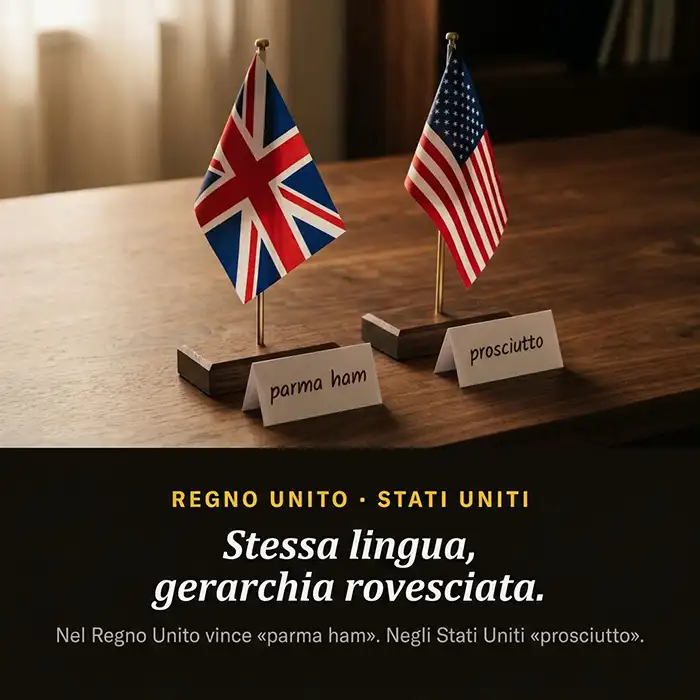
The United Kingdom and the United States speak the same language but are looking for different things
| Term | United Kingdom | United States |
|---|---|---|
| ham | — | 165.000 |
| Parma ham | — | 22.200 |
| Parma ham | 6.600 | 4.400 |
| raw ham | 2.400 | 4.400 |
| Italian ham | 1.600 | 5.400 |
In the United Kingdom, “Parma ham” is the dominant term, used nearly three times as often as the Italian term. In the United States, “prosciutto” is the dominant term, with a ratio of thirty-seven to one compared to “Parma ham.” Same language, reversed hierarchy.
This has a practical implication: the English version of a website is actually two versions—a British one and a U.S. one—each with its own vocabulary and content priorities.
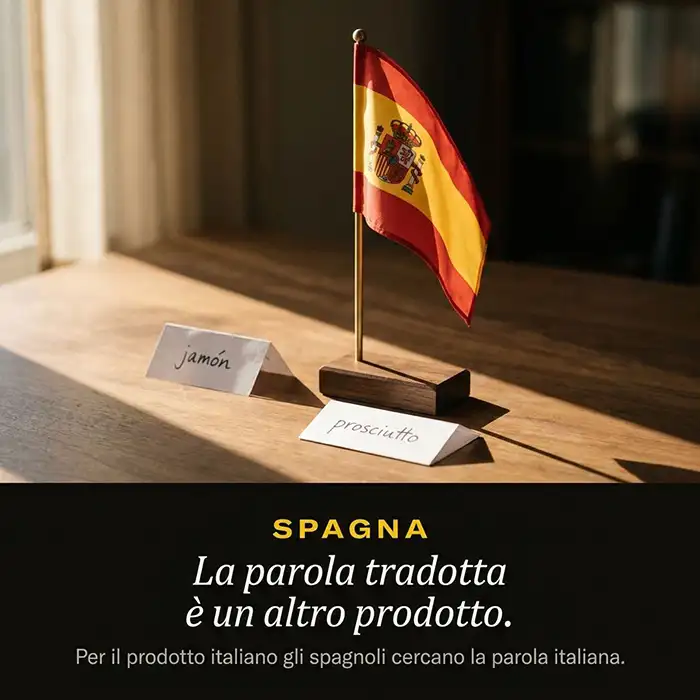
In Spain, the translated word refers to a different product
A literal translation of “prosciutto crudo” is “jamón,” a term that in Spain refers to both Serrano and Ibérico ham.
When searching for this Italian product, Spaniards use the Italian term: “prosciutto” accounts for 8,100 monthly searches, while “jamón de Parma” accounts for 1,900 and “jamón italiano” for 590.
Italian jamón serrano also makes an appearance, which allows the national category to gain recognition through another country’s product.
In Spain, the translated word refers to a different product
| How Spaniards Search | Searches per month | Formulation Type |
|---|---|---|
| ham | 8.100 | Italian word |
| Jamon de Parma | 1.900 | Spanish architecture |
| prosciutto (misspelled) | 1.300 | Italian word |
| Parma ham | 880 | Italian word |
| Italian Parma ham | 880 | English |
| Parma ham | 720 | English |
| Italian ham | 590 | Spanish category plus other nationalities |
| Parma ham | 480 | Spanish architecture |
| What is prosciutto? | 320 | quest for meaning |
| Jamon Parma | 260 | Spanish architecture |
| Italian Serrano ham | 170 | overlapping Spanish category |
| Italian ham | 140 | Spanish category plus other nationalities |
One detail illustrates the maturity of the market: searches for variations on “qué es prosciutto” total about 800 per month.
Searches for variations of “qué es prosciutto” total about 800 per month: in Spain, the product is still at the stage where people are asking what it is.
A literal translation of “prosciutto crudo” yields “jamón,” a word that in Spain refers to both serrano and ibérico ham. The translated term does exist, therefore, but it refers to a different product.
Spaniards use the Italian word for the Italian product.

In France, it’s the meaning that changes, rather than the word itself
The translated term works very well: “jambon de parme” has 8,100 searches. The literal translation of “prosciutto crudo”—that is, “jambon cru de parme”—only has 40.
The real issue, however, concerns the content: French search interest is focused on usage. The cluster of searches related to melons exceeds 2,000 per month, followed by pizza, recipes, storage, and calories.
| How the French Search | Searches per month | What do they want to know? |
|---|---|---|
| Parma ham | 8.100 | the product |
| melon and Parma ham | 390 | how to pair it |
| Parma ham with melon | 320 | how to pair it |
| Parma ham and melon | 260 | how to pair it |
| Melon with Parma Ham | 260 | how to pair it |
| melon and Parma ham | 260 | how to pair it |
| Pregnant Parma ham | 260 | whether it’s safe during pregnancy |
| Pizza with Parma Ham | 210 | How to Use It in the Kitchen |
| Pizza with Parma Ham | 170 | How to Use It in the Kitchen |
| Price per kg of Parma ham | 110 | How much does it cost? |
| Parmigiano-Reggiano prosciutto | 40 | the literal translation of “prosciutto crudo” |
Searches related to “melon” alone total about 1,500 per month, and that number exceeds 2,000 when you include presentations, skewers, and recipes.
The comparison between the first line and the last says it all: 8,100 searches for the term used in the market, 40 for the literal translation.
And the bottom of the table shows that the French description focuses on how to use the product, while the Italian product description describes the product itself.
A product page translated into French is left out of all this. We need recipe content and suggestions for when to enjoy the product, which are often completely missing from the Italian website.
Two trends that emerge solely from the data: typos
The first concerns misspellings. In the United States, “proscuitto” accounts for 6,600 searches, and when you add up the other misspellings, the total exceeds 12,000 per month.
In Spain, this phenomenon accounts for about 2,300. In a foreign market, misspellings of a product’s name can be worth more than the correct name in the domestic market. This is evident only from the research data.
The second point concerns concerns. In the United States, “raw ham” accounts for 2,900 searches, and the total number of questions about safety and health comes to around 9,000.
| Spelling error | United States | Spain | Italy |
|---|---|---|---|
| prosciutto | 6.600 | 170 | 140 |
| prosciutto | 1.300 | — | 720 |
| prosciutto | 1.300 | — | — |
| prosecuted | 1.000 | — | — |
| prosciutto | 880 | — | 110 |
| prosciutto | 720 | — | — |
| prosciutto | 720 | 1.300 | 210 |
| prochuto | 590 | 90 | — |
| ham | 590 | — | — |
| prosciutto | 590 | 90 | — |
| prochutto | 480 | — | — |
| resulting | 480 | 70 | — |
| procuto | 480 | — | — |
| outlaw | 390 | — | 90 |
| prosciutto | 390 | — | — |
| prosciutto | — | — | 210 |
| prosciutto | — | 140 | — |
| cured | — | 110 | 70 |
| Total, including the tail | more than 20,000 | about 2,500 | about 2,900 |
In the United Kingdom, the phenomenon remains limited, at around 380 searches per month. Entries with more than 200 monthly searches are listed; the rest includes several dozen additional variants.
In the United States, people who spell the product’s name incorrectly account for more searches than the entire Italian market that spells it correctly: incorrect spellings alone exceed 20,000 monthly searches, while in Italy, “prosciutto crudo” accounts for 14,800.
New terms that do not exist in the Italian market
In the United States, the term “prosciuttini” generates 12,100 monthly searches. It is a term coined by the U.S. market for a type of cured meat that goes by a different name in Italy. It is therefore a local invention rather than a mistake.
Four markets, four different sets of content. All of them stem from local demand, while the original website only provides the Italian version.
The Three Steps Between Translation and Strategy
Between the translated website and the comprehensive strategy, there is an intermediate step that very few people pay attention to. It’s worth laying it out.
Step One: Translation
Existing content is translated into another language. This helps those who find you through other channels understand your content and sends the signal of openness we were discussing. It’s the entry-level approach, and for many businesses, it remains the right choice for a long time.
Step 2: Data-Driven Translation
The same pages, with the words that people actually use in that language. It requires some basic research on keywords for the target market, while maintaining the current structure and existing content. It costs very little but makes a big difference.
Step 3: The International SEO Strategy
This is where new demand is generated. You choose the domain architecture, implement the hreflang attributes, build a keyword map for each market, and produce content tailored to that country, with native-speaking contributors. This is the level that drives traffic from people who are not yet aware of your existence.
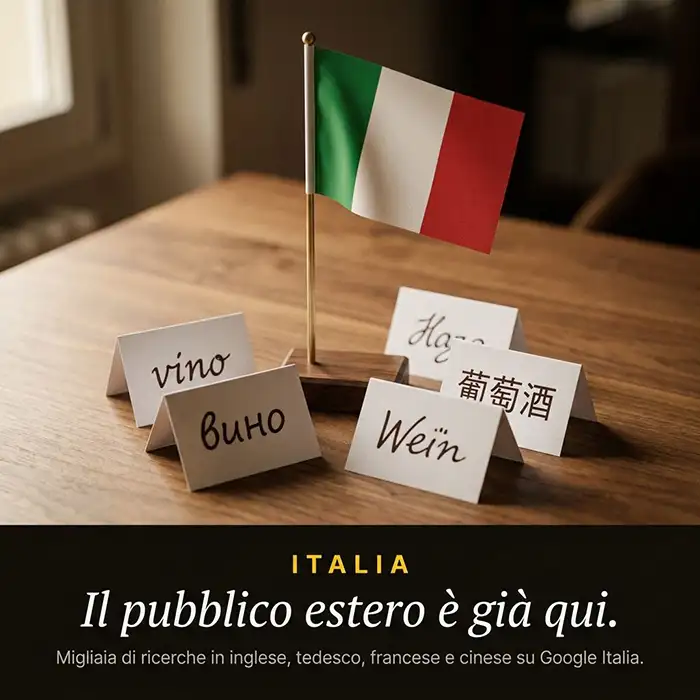
The second step: foreign demand that is already in Italy
There’s one aspect that almost always gets overlooked. When you query the Italian Semrush database using foreign words, search queries from Google Italy appear in languages that aren’t spoken in Italy.
| Search | Monthly volume | Language |
|---|---|---|
| Parma ham | 1.900 | English |
| Italian Parma ham | 1.900 | English |
| prošuto, pršut | about 900 | Croatian, Serbian |
| raw ham | 720 | English |
| Parma | 480 | Chinese |
| cured ham | 480 | English |
| Parma ham | 320 | German |
| Parma ham | 140 | French |
Chinese and Croatian are the clearest indicators, because they come from people who are from outside.
Next to these are search terms related to the visit: “Parma Prosciutto Museum” accounts for 1,000 monthly searches, “visit a prosciutto factory in Parma” for 210, and “Parma prosciutto tastings” for 90.
The picture is clear. Tourists, foreign residents, and international buyers based in Italy: a foreign audience that is physically here and searches in its own language.
This trend is even more pronounced in the restaurant, hospitality, and food industries than in any other sector.
A note on methodology: The Italian database records searches conducted on Google Italy, which largely corresponds to searches made while in Italy, with a few exceptions.
The signal is strong, and should be interpreted as an indication rather than an exact measurement.
When You Need an International SEO Strategy
Let’s summarize the cases in which moving to the third step yields tangible results.
- This strategy targets new customers who aren’t familiar with your name right now. Those who already know you are satisfied with a translation, while those who need to discover you will find you through a search.
- There are more than two target markets. Beyond this threshold, coordinating languages, content, and data requires a systematic approach.
- The product has different names from country to country, as we saw earlier. Here, the keyword map becomes the foundation for everything.
- The site is already multilingual, yet the rankings remain stagnant. This is usually due to technical issues: incomplete hreflang tags, duplicate content across versions, or incomplete sitemaps.
- The target market is asking questions that the Italian website doesn’t address—about safety, usage, or consumption scenarios.
Apart from these cases, the first or second step remains a sensible choice. Fattoretto Agency had already raised this issue in an article dedicated to the relationship between translation and international SEO: we agree with their argument, and these data put it to the test in practice.
Our Case: Why the English Website Is a Translation
The English version of the Factory Communication website is a translation. It launched in December, and in eight months it has generated these figures, taken from Search Console.
| Metrics | Value |
|---|---|
| Impressions | 790.414 |
| Click | 1.080 |
| Average ranking in Italy | 14,2 |
| Average location in the United States | 43,0 |
| Average location in the United Kingdom | 45,2 |
The interesting part is in the last three lines. The English-language pages rank 14th in Italy and around 43rd in the two English-speaking markets for which they are written.
Three times better in the country where English is spoken the least.
The reason aligns with the article’s argument: the domain’s authority is Italian, the inbound links are Italian, and the geographic signals are Italian as well.
Google ranks that site in Italy and keeps it there, even when the content is in English. In foreign markets, it enters a competitive landscape where it still needs to build up positive signals in its favor.
Italy also accounts for 23% of impressions broken down by country and one-third of clicks. It is the leading market for our English-language website, with a significant lead over the second-place market.
This is the reason behind our decision. Today, we operate primarily in the Italian market, so this first step is consistent with our strategy.
The translated website is designed for the international audience in Italy and for those considering expanding abroad with us. When foreign markets become a business objective, we will take the third step.
Frequently asked questions
It refers to the set of activities that make a website visible in search engines across multiple countries: keyword research on a market-by-market basis, selection of the domain architecture, implementation of hreflang attributes, and creation of content in the native language. It starts with the actual demand in each country.
Translation makes the website understandable to visitors who find it through trade shows, referrals, or social media. To reach those who are not yet familiar with the company, it’s necessary to research the terms actually used in that market, because the most frequently searched term is often left out of a literal translation.
This is true even among countries that share the same language. In the United Kingdom, “Parma ham” receives 6,600 monthly searches, compared to 2,400 for “prosciutto crudo”; in the United States, “prosciutto” receives 165,000 monthly searches, compared to 4,400 for “Parma ham.” The hierarchy is reversed between these two English-speaking markets.
It is an HTML attribute that tells search engines which pages are linguistic or geographic versions of one another.
When configured correctly, it directs each user to the version intended for their country and allows the different versions to add value rather than compete with one another.
For most SMEs, subfolders are the most efficient choice because they concentrate authority on a single domain.
Country-specific domains convey the strongest geographic signal and require dedicated resources for each country. Subdomains fall somewhere in between.
Yes. The Italian database shows thousands of monthly searches in English, German, French, Chinese, and Croatian for Italian products.
Tourists, foreign residents, and international buyers based in Italy search in their own languages, and the translated pages capture their interest.
The first signs typically appear within three to six months, while achieving a solid ranking takes nine to twelve months.
The timeframe depends on the domain’s authority, the competitiveness of the chosen market, and the volume of content published in that language.
Based on a keyword analysis of the target market, conducted using data from that country.
It’s inexpensive, takes just a few days, and produces a map that helps you decide whether to stop at the second step or move on to the full strategy.
The first step in counseling is listening
If you’re considering foreign markets, a good place to start is to understand how customers are already finding you. Let’s take a look at the data for your industry in the countries you’re interested in and determine which step makes sense for your company.
Request a free consultation. If you’d like to learn more about our approach, you’ll find all the details on our page dedicated to international SEO consulting.
Data Sources
- Semrush, Keyword Overview and All Keywords reports, databases for Spain, France, the United States, Italy, and the United Kingdom.
- Draws on July 23, 2026. The figures represent average monthly search volumes.
- The tables exclude entries resulting from Balkan transliterations, such as prošuto and pršut, which represent a phenomenon distinct from misspellings.